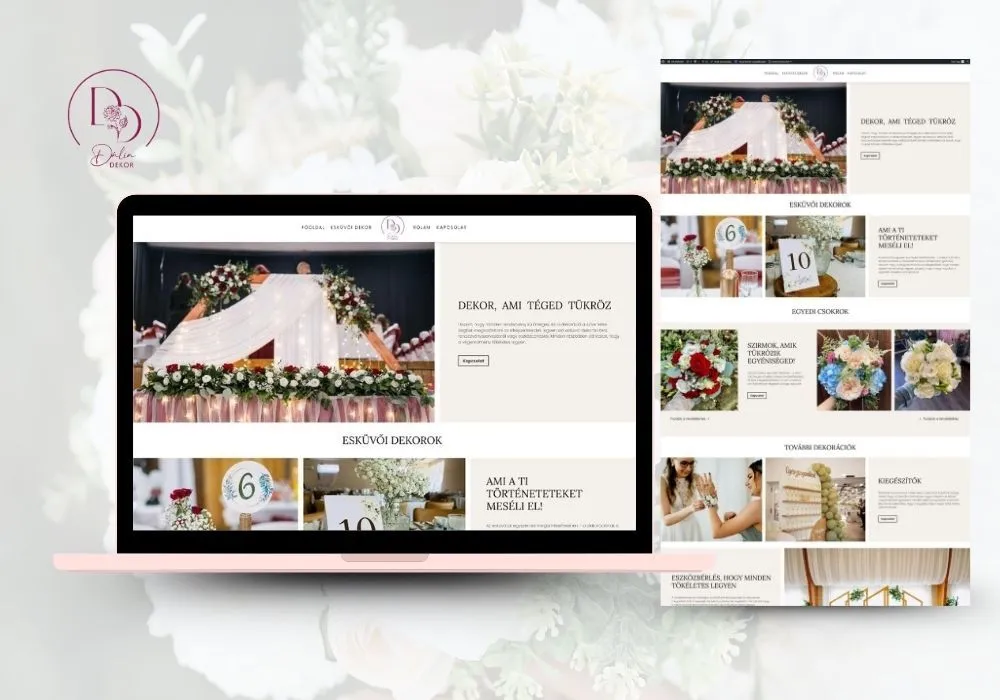


Renting a website or having your own built? We show you the differences, the costs, and the pros and cons of both.
Most businesses can save – or lose – hundreds of thousands of forints with their very first decision. In this article we explain in detail when it’s worth having your own website built, when renting a website is the better choice, and which option pays for itself faster for a small or medium-sized business.
A question every business faces sooner or later
If you’re starting a business, or you feel the time has come for a more modern website, you’ll almost certainly run into this question:
Should I have a website built for a one-off fee, or rent one with a monthly subscription?
At first glance the answer may seem simple. Many people think that owning your website is always cheaper in the long run, while renting is just an ongoing expense.
The reality, however, is much more complex.
A modern business website isn’t just a few finished pages. For it to run securely, quickly and reliably for years, it also needs ongoing maintenance, updates, backups, hosting, a domain and technical supervision.
Many people only see the development price, while the real costs of a website turn up months or years later.
That’s exactly why more and more Hungarian businesses are choosing to rent a website: instead of investing hundreds of thousands of forints at once, they pay a predictable monthly fee and specialists take care of every technical task.
But is it really the better decision?
In this guide we compare the two options in detail and look at the costs, the advantages and the disadvantages, so that by the end of the article you’ll know exactly which one suits your business best.
What’s the difference between having a website built and renting one?
Although they may sound like similar services at first, the two options represent completely different approaches.
What does having a website built mean?
In traditional website development, a developer or web agency builds your website for a one-off fee. Once the project is finished, they usually hand over the completed site, which you then have to maintain yourself – or you can order maintenance separately.
In most cases the initial fee only covers building the site. Later expenses – such as hosting, domain renewal, backups, WordPress updates or bug fixes – are paid for separately.
This means that building the website is really just the first step. For the site to keep working properly in the long run, it needs regular technical supervision.
What does renting a website mean?
Renting a website is a subscription model designed so that a business doesn’t have to deal with every technical detail separately.
For a monthly fee you don’t just get a modern, professional website – you usually get the following services too:
- a custom, responsive website
- the domain
- fast and secure hosting
- an SSL certificate
- regular WordPress and plugin updates
- backups
- technical maintenance
- bug fixing
- customer support
- continuous monitoring
This means the business doesn’t have to look for a developer every time a small change or a technical problem comes up.
The website always stays up to date, while the monthly costs can be planned in advance.
Why has the market changed in recent years?
A few years ago, most companies had their website built once and then didn’t touch it for years.
Today that’s a serious risk.
A website that isn’t updated for months or even years can not only become slower over time, but also vulnerable from a security point of view.
Visitors’ expectations have also changed significantly. A mobile-friendly layout, fast loading, an HTTPS connection, simple navigation and reliable operation are now basic requirements.
A website is no longer a one-off investment but a business tool that runs continuously and needs maintenance just like a company car or an IT system.
That’s why the subscription-based website rental model has become more and more popular: it takes these tasks off businesses’ shoulders.
What can you expect in the rest of this article?
In the following sections we’ll show you in detail:
- how much it really costs to build and run a website,
- which hidden costs you should account for,
- when it makes more sense to rent a website,
- in which cases building your own is the better choice,
- and we’ll compare the two models through real business examples.
Our aim isn’t to push everyone in the same direction, but to give you the information you need to make a well-founded decision about your business’s future.
How much does a business website really cost?
Many people think the cost of a website is the amount they pay the developer to build it. In reality, that’s only the initial investment.
A modern WordPress website needs a number of services to keep running, each with an annual or monthly cost. If we don’t take these into account, it’s easy to underestimate the total cost of running the site.
That’s why it’s worth looking not at how much it costs to build, but at how much it costs to run over 3–5 years.
The real costs of owning a website
Let’s say a small business wants a modern, professional company website.
On top of the one-off development fee, you’ll usually need to account for the following costs (the figures reflect typical prices on the Hungarian market):
| Cost | Expected amount |
|---|---|
| Building the website | HUF 300,000 – 800,000 |
| Domain | HUF 5,000 – 15,000 / year |
| Hosting | HUF 20,000 – 80,000 / year |
| SSL certificate | often included with hosting |
| WordPress maintenance | HUF 15,000 – 60,000 / month |
| Backups | a separate service or working hours |
| Bug fixing | hourly rate |
| Content changes | hourly rate |
| Premium plugins | annual subscription |
| Speed optimisation | paid per occasion |
Not every business pays separately for every item, but together they can add up to a significant expense in the long run.
The hidden costs few people account for
When requesting quotes, most business owners only compare the one-off development fee.
Yet the real costs often come later.
1. Updates
WordPress, themes and plugins are updated all the time.
If these updates are skipped:
- the security risk grows,
- compatibility errors can appear,
- certain features may stop working.
2. Bug fixing
After an update, it can happen that:
- the quote request form stops working,
- emails don’t arrive,
- a page disappears,
- the payment system throws an error,
- or you’re simply greeted by a white screen.
In these cases you usually need a developer, whose hourly rate is often between HUF 15,000 and 40,000.
3. Security
Restoring a hacked website can not only be expensive but can also cause serious damage to your business.
For example:
- Google may flag the site as dangerous,
- spam content may be added,
- data may be lost,
- or the entire website may have to be rebuilt.
Prevention is almost always cheaper than recovery.
4. Content changes
Many people think that once the website is finished, there’s nothing more to do.
In reality, almost every business wants to change something from time to time:
- a new service is added,
- prices change,
- a new colleague joins,
- new photos need to be uploaded,
- blog posts are written,
- promotions appear.
If you have to pay separately for every small change, these add up to a considerable sum over a few years.
What could the total cost be over three years?
Let’s take a simple example.
A business (not us) has a WordPress website built for a one-off HUF 550,000.
Over three years it can expect the following costs:
| Cost | Over 3 years |
|---|---|
| Website development | HUF 550,000 |
| Domain | HUF 30,000 |
| Hosting | HUF 120,000 |
| Maintenance | HUF 540,000 |
| Premium plugins | HUF 90,000 |
| Occasional changes | HUF 150,000 |
Total:
HUF 1,480,000
And that doesn’t yet include:
- unexpected bug fixes,
- malware removal,
- speed optimisation,
- larger development work,
- adding new features.
This is of course only an example, but it shows clearly that the real cost of a website can be much higher than the initial development fee.
How does renting a website work, by contrast?
One of the biggest advantages of renting a website is transparency.
Instead of paying separately for each service, you get a complete package for a monthly fee.
It typically includes:
- building a professional website,
- the domain,
- hosting,
- an SSL certificate,
- regular WordPress updates,
- backups,
- technical supervision,
- bug fixing,
- ongoing maintenance,
- customer support.
As a result, the business knows exactly what monthly expense to plan for, and isn’t hit by unexpected costs because of an update or a technical problem.
The cheaper option isn’t always the better decision
Many people decide purely on the initial cost.
Yet a website isn’t a one-off expense, it’s a long-term investment.
It’s also worth considering:
- how much time it takes to deal with technical problems,
- how much downtime costs you,
- how much revenue you could lose if the website doesn’t work properly,
- and how much energy you want to spend on running the website.
For many businesses, the most important thing isn’t who does the updates, but that the website always runs quickly, securely and reliably.
This is the mindset that’s leading more and more people to choose renting a website over traditional development.
Renting a website or having one built? A detailed comparison
Now that we’ve looked at the costs, let’s see how the two options differ in everyday use.
The aim isn’t to declare one better than the other in every case. The right choice always depends on the size, goals and available budget of the business.
The comparison below will help you see clearly.
1. Upfront costs
Having a website built
With traditional development, one of the biggest expenses comes right at the start.
In Hungary, a professional company website typically costs between HUF 300,000 and 1,000,000, and more complex projects can cost even more.
That can be a serious investment for a new business.
Advantages
- a one-off investment
- the solution can be completely custom
- a lot of freedom during development
Disadvantages
- high upfront cost
- maintenance is paid for separately
- most changes mean another developer fee
Renting a website
When you rent a website, there’s no need for a one-off investment of hundreds of thousands of forints.
The business pays a fixed monthly fee that covers both building and maintaining the website.
Advantages
- low upfront cost
- an easy-to-plan monthly expense
- doesn’t drain the business’s financial reserves
Disadvantages
- an ongoing monthly subscription
- in the longer run, the total amount paid may be higher than the price of a one-off build – but in return you also get an ongoing service.
2. Maintenance
This is one of the biggest differences.
Your own website
Once development is finished, maintenance is usually the owner’s job.
This can include:
- WordPress updates,
- managing plugins,
- backups,
- malware checks,
- fixing bugs,
- performance optimisation.
If you don’t have the technical experience, these are usually done by an outside specialist.
Renting a website
Maintenance is part of the service.
The business doesn’t have to keep track of:
- when a new WordPress version has been released,
- which plugin has been updated,
- whether a backup is needed,
- or whether every feature is still compatible.
The provider takes care of all of this.
This is especially important for businesses that would rather focus on winning clients and day-to-day operations.
3. Security
The number of cyberattacks grows year after year.
An outdated WordPress website can be an easy target.
Your own website
If there’s no regular maintenance:
- the risk of being hacked increases,
- customer data can be compromised,
- the website can go down,
- Google may warn visitors.
Renting a website
Most providers continuously monitor the state of the system.
They typically provide:
- regular updates,
- backups,
- malware checks,
- fast bug fixing,
- technical supervision.
As a result, the risk of security problems drops significantly.
4. Flexibility
This is where many people jump to the wrong conclusion.
Many assume that a rented website is harder to customise.
That, however, depends on the provider.
With a modern, WordPress-based website rental service you can still:
- create new pages,
- run a blog,
- use a contact form,
- build a gallery,
- integrate a booking system,
- launch a webshop,
- optimise the site for search engines.
The real question is which package you choose and what development work the service includes.
5. Technical support
Imagine the following situation.
On a Friday evening, a quote request comes in from a potential client.
But the form doesn’t work.
The visitor closes the page and turns to a competitor.
That’s not just a technical error, it’s a lost business opportunity.
With your own website
It can happen that:
- the developer is on holiday,
- doesn’t work at weekends,
- or can only fix the problem in a few days.
With a rented website
Technical support is usually part of the service.
This means that if there’s a problem, you don’t have to look for a separate specialist or request a new quote – troubleshooting is handled through a single point of contact.
6. SEO and Google rankings
Many people think Google favours websites you own.
That’s not true.
For Google it doesn’t matter whether a website is rented or owned.
What matters is that the site:
- is fast,
- is mobile-friendly,
- is secure,
- offers valuable content,
- has a sound technical foundation.
If the website rental service provides these, the site can achieve just as good results from an SEO point of view.
Quick comparison
| Aspect | Having a website built | Renting a website |
|---|---|---|
| Upfront cost | High | Low |
| Monthly expense | Variable | Predictable |
| Maintenance | A separate service | Usually included |
| Hosting | Paid separately | Mostly included |
| Domain | Paid separately | Included in many packages |
| Bug fixing | Hourly rate | Typically included |
| Backups | Need to be arranged separately | Usually included |
| Technical support | Ad hoc | Ongoing |
| Starting capital needed | High | Low |
| Cost predictability | Variable | Excellent |
Which is the better choice?
There’s no answer that applies to every business.
If you want a custom-built system, have your own IT team, and a high initial investment isn’t a problem, then traditional website development may be the right path.
But if predictable costs, ongoing technical support, maintenance and not having to find a developer for every change matter to you, then renting a website can in many cases be the more practical and convenient solution.
When deciding, don’t just look at how much it costs to build the website. Think about how much it will cost to run it securely, quickly and up to date for years. A well-functioning website isn’t a one-off project – it’s one of your business’s most important online tools.
Which option suits whom? – Real business examples
After the theoretical comparison, let’s look at the question in practice.
The examples below will help you decide whether renting a website or a one-off build is the better choice for a particular business.
1. A new business
Example: A new accounting firm, electrician or marketing consultant is just starting out.
The business needs:
- a professional appearance,
- a contact form,
- a presentation of its services,
- visibility on Google,
- a blog.
At the same time, every forint counts at the start.
In this case, a one-off investment of hundreds of thousands of forints can be a serious burden.
Recommended option:
Renting a website
Why?
- low upfront cost,
- a quick start,
- no separate hosting,
- no separate maintenance,
- predictable monthly costs.
2. A local service provider
For example:
- a hairdresser,
- a beautician,
- a car mechanic,
- an air-conditioning installer,
- an electrician,
- a lawyer,
- a dentist.
Their most important goals:
- more phone calls,
- more quote requests,
- better Google rankings.
They’re usually not interested in the technical background – all that matters is that the website always works.
Recommended option:
Renting a website
Because the provider takes the technical tasks off the business’s shoulders, the company can concentrate on its own clients.
3. A fast-growing small business
The business keeps developing.
New services appear.
New colleagues join.
New pages are created.
In this case it’s important that the website is easy to expand and that there’s professional support behind it that can make the necessary changes quickly.
Recommended option:
In most cases, renting a website again – especially if the package includes regular changes.
4. A company that needs custom development
Some companies use specialised systems.
For example:
- a custom client portal,
- ERP integration,
- an enterprise management system,
- a custom calculator,
- an internal client interface.
In these cases, fully custom development is often needed.
Recommended option:
A custom-built website of your own
Here, flexibility and custom functionality matter more than the advantages of the subscription model.
5. A business launching a webshop
Many people think that a webshop can only be built as a one-off development.
That’s no longer necessarily true.
For a small or medium-sized webshop, renting a website can be an excellent option, provided the package includes the features you actually need.
If, however, you manage tens of thousands of products, use custom logistics systems or need complex enterprise integrations, then custom development may be the right direction.
The key takeaway
The question isn’t which option is better, but which one fits the business’s current situation and goals better.
For most small and medium-sized businesses, a quick start, predictable costs and ongoing technical support are worth more than full ownership.
That’s why more and more of them choose to rent a website – especially if they don’t want to deal with technical tasks and would rather focus on growing their business.
When is renting a website not recommended?
Renting a website can be an excellent solution for many businesses, but it isn’t the best choice in every situation.
If a provider claims that renting a website is ideal for every company, it’s worth taking that claim with a pinch of salt. Every business has different needs, so it’s important to make the decision based on them.
Let’s look at the cases where it may be better to opt for traditional website development.
1. You need custom-built systems
If your website has to perform functions that go beyond a typical company website or webshop, you’ll probably need custom development.
These might include:
- your own client portal,
- a connection to a custom enterprise management system,
- complex ERP integration,
- applications that handle internal workflows,
- custom calculators,
- specialised databases.
These projects usually require custom development and ongoing developer work.
2. You have your own development team
Larger companies often employ:
- a web developer,
- a system administrator,
- a DevOps specialist,
- a marketing team.
In this case many technical tasks can be handled in-house.
If the website is maintained by your own staff, the advantages of the rental model matter less.
3. Very specific business needs
Some projects require an entirely custom architecture.
For example:
- banking systems,
- insurance platforms,
- healthcare systems,
- high-traffic marketplaces,
- SaaS applications.
These typically aren’t simple websites but complex pieces of software.
4. You want full control over every detail
For some businesses it’s important to:
- have access to every file,
- use their own server,
- build a custom infrastructure,
- make every technical decision in-house.
In this case a one-off development can offer more freedom.
Myths about renting a website
Renting a website is an increasingly popular service, yet it’s surrounded by plenty of misconceptions. Some of them no longer reflect today’s market practice.
Myth #1: “A rented website is always lower quality.”
That’s not true.
The quality of a website isn’t determined by whether you buy it or rent it, but by the professional work that goes into it.
A well-designed, modern WordPress website can be fast, secure, search-engine optimised and user-friendly under a rental arrangement too.
Myth #2: “Google ranks rented websites lower.”
That’s a myth as well.
Google doesn’t look at the business arrangement under which your website was made.
Rankings are influenced by factors such as:
- page speed,
- content quality,
- a mobile-friendly design,
- technical SEO,
- user experience,
- reliability.
If these are in order, renting a website means no SEO disadvantage at all.
Myth #3: “Renting a website is always more expensive in the long run.”
Not necessarily.
If you only compare the one-off development fee with the monthly subscription, it’s easy to reach that conclusion.
But if you factor in:
- hosting,
- the domain,
- maintenance,
- backups,
- bug fixes,
- premium plugins,
- technical support,
the picture becomes much more nuanced.
For a real comparison, you should always consider the total lifecycle cost.
Myth #4: “If I rent my website, it can’t be professional.”
This is one of the most common misconceptions.
The quality of a professional website is determined not by the business model, but by the design, the development, the content and the way it’s run.
Many small and medium-sized businesses use rented websites that are in no way inferior to one-off builds in appearance or functionality.
What to look for when choosing a provider
Whether you decide to rent a website or have one built, choosing the right provider is crucial.
It’s worth asking the following questions:
- What exactly does the price include?
- Is there regular maintenance?
- Does it include hosting and the domain?
- What happens if something goes wrong?
- How fast is support?
- Do they help with search engine optimisation?
- Can the website be expanded later?
- Are there any hidden costs?
If you get clear answers to these questions, it’ll be much easier to choose a solution that supports your business’s growth in the long term too.
Frequently asked questions about renting and building a website
If you’ve made it this far, you probably already have a sense of which option is closer to your business’s needs. The questions below sum up the most common dilemmas and will help you make the final decision.
How much does a professional company website cost in 2026?
There’s no single right answer, as the price depends on many factors:
- how many pages are created,
- whether custom features are needed,
- whether copywriting is included,
- what kind of graphic design is needed,
- whether search engine optimisation is included.
A simple presentation website typically costs less, while a more complex corporate site or webshop can cost significantly more.
Is renting a website more expensive in the long run?
Not necessarily.
If you only compare the development fee with the monthly subscription, it can easily look that way.
But if you take into account:
- hosting,
- the domain,
- SSL,
- maintenance,
- backups,
- bug fixing,
- technical support,
in many cases the total costs of the two models are closer to each other than you might first think.
Can a rented website be optimised for search engines?
Yes.
Google makes no distinction between rented and owned websites.
What matters to the search engine is whether:
- the site is fast,
- it’s mobile-friendly,
- it’s secure,
- it offers valuable content,
- it has proper technical SEO.
How quickly can a website be built?
That always depends on the complexity of the project.
A simple company website can be ready in a few weeks, while a more complex system or webshop can take longer to develop.
The exact deadline also depends on how quickly the necessary texts, images and other content are available.
What happens if I need a new feature later?
It’s always worth clarifying this with the provider in advance.
Many website rental arrangements allow the website to be extended later with new features, pages or integrations.
Who is renting a website best suited to?
Typically, businesses that:
- are just starting out,
- want a predictable monthly cost,
- don’t want to look for a separate developer,
- value ongoing technical support,
- would rather concentrate on their business.
Who is traditional website development better suited to?
Mainly those who:
- want custom systems,
- have their own development team,
- use specialised integrations,
- want full control over the infrastructure.
Does renting a website include maintenance?
That can vary from provider to provider.
That’s why, before requesting a quote, it’s always worth checking exactly which services the monthly fee covers.
Why is regular maintenance important?
Regular maintenance helps to:
- prevent security problems,
- ensure compatibility,
- keep the site running fast,
- reduce the chance of downtime,
- preserve the user experience.
How long can a well-built website be used?
A modern website can serve a business for years, provided it’s regularly maintained, updated and adapted from time to time to changing business needs.
A website isn’t a one-off project but an online tool that keeps evolving.
Summary
There’s no answer to the question of renting a website or having one built that applies to every business.
The right decision depends on:
- what your goals are,
- what budget you have,
- how much time you want to spend on technical tasks,
- how quickly you want to get started,
- and what support you’ll need later on.
If full control matters to you, you need custom development and you have the right technical background, then traditional website development may be the right path.
If, however, you’re looking for predictable costs, ongoing maintenance, technical support and simpler operation, then renting a website can in many cases be the more convenient and cost-effective solution.
The best decision is always the one that fits not only your current needs, but also your business’s future growth.
Ask for personalised advice
Every business is different, so there’s no one-size-fits-all solution.
If you’re not sure whether renting a website or a one-off website build would be the better choice, it’s worth talking the options through with an expert.
In a short consultation we can assess your needs, your business’s goals and your available budget, so you can choose a solution that supports your online presence and business growth in the long term.